Situational Judgement Test - Free Practice
SJTs feel like there is no right answer. There is a scoring logic - practise free here and learn how the most/least effective marking works.
Practise free now
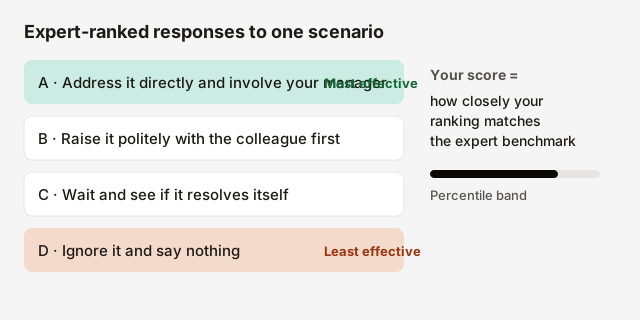
A situational judgement test gives you a workplace scenario and asks for the most (and sometimes least) effective response. Answers are scored against a panel of experts, so consistency with professional judgement - not a gut reaction - wins marks.
Scenarios usually revolve around a small number of themes: handling a difficult customer or colleague, prioritising under pressure, escalating a problem versus solving it yourself, and acting with integrity when a shortcut is tempting. Employers map the "best" answers to their own values or competency framework, which is why the same scenario can be scored differently by different companies. There is still a clear strongest and weakest option in each one, even when two or three look reasonable.
The reliable approach is to favour responses that are proactive, honest, and consider the wider team or customer, and to be wary of options that are passive, purely self-protective, or that skip a step a professional would not skip. Practise the free scenarios below, then read why each strongest and weakest option scores as it does. Every question here is free with a full worked answer, no signup and no card.
Common questions
How is a situational judgement test scored?
Is there a right answer in an SJT?
Written and reviewed by the Aptitude Practice editorial team. Last reviewed 9 July 2026. See how we build and check our tests in our methodology. Independent practice, not affiliated with any test publisher or employer named.